Chasing the Mountain
Photographing Mount Fuji
Chasing the mountain
There is a reason photographers wake up at 4:00 AM. It's not because we enjoy fumbling for our gear in the dark. It's because sometimes — just sometimes — the mountain decides to show up. This guide shares practical tips for photographing Mount Fuji, from 4am starts and near-perfect reflections to using the pagoda and telephoto lens. Field-tested advice from my Japan photography workshop. If you're travelling to Japan, consider getting an eSIM from Airalo to stay connected without expensive roaming charges.
There is a reason photographers wake up at 4:00 AM.
It's not because we enjoy fumbling for our gear in the dark. It's not because we like the feeling of jet lag battering us. It's because sometimes — just sometimes — the mountain decides to show up.
And when it does, you want to be there.
On our Japan photography workshop, we spent several days chasing Mount Fuji — the legendary Fuji-san — from pagodas, lakesides, and mountain passes. It was a rollercoaster of highs and lows. Some mornings, the mountain hid behind thick cloud. Other times, it revealed itself in spectacular fashion, standing clear against the crisp morning air with near-perfect reflections dancing on the water.
Here's what I learned along the way.

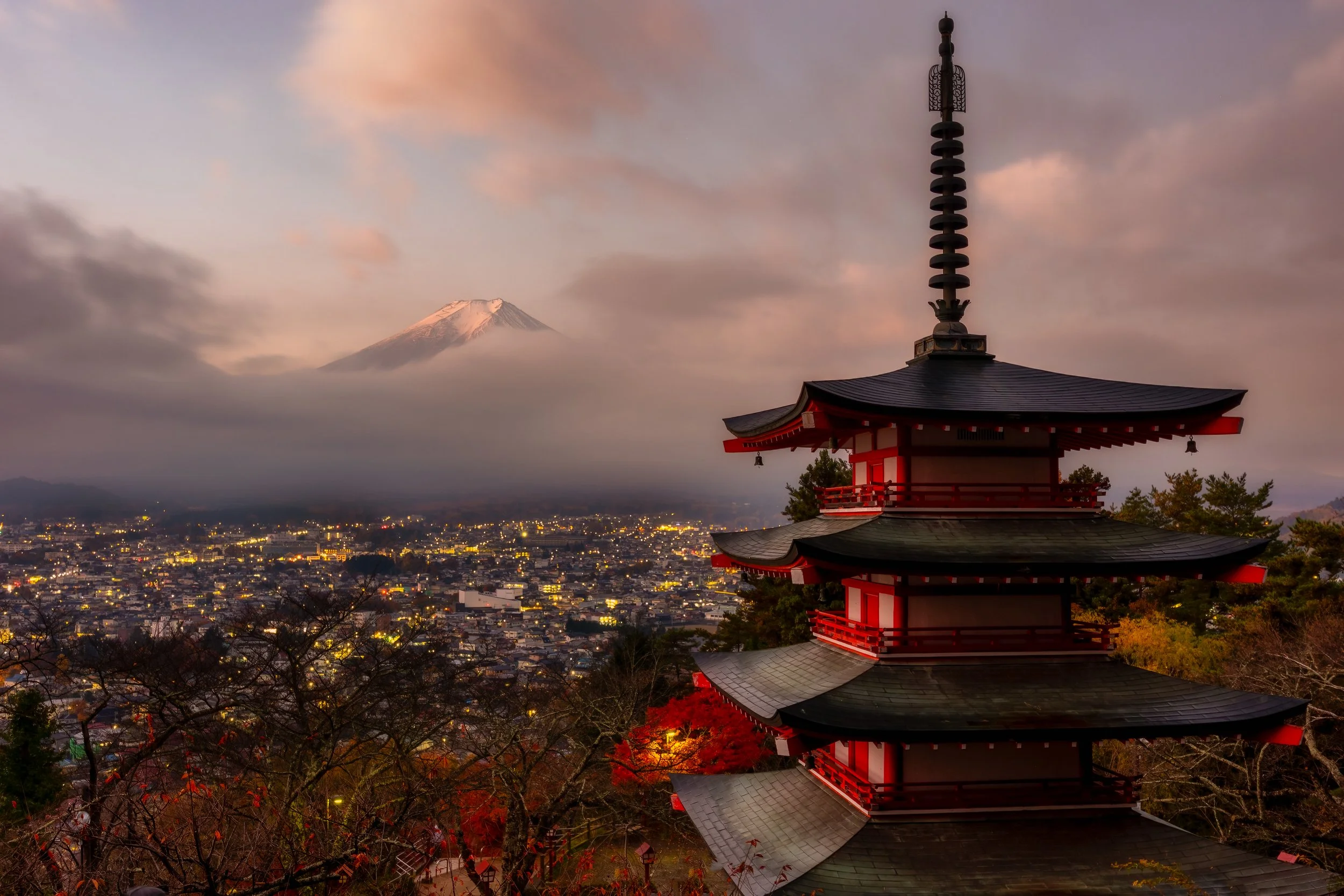
The iconic pagoda shot — Fuji-san standing clear against the morning sky.
1. The Early Bird Gets the Reflection
If there is one piece of advice I can give you about photographing Mount Fuji, it's this: get there before dawn.
We were out at the pagoda by 4:30 AM, and it was one of those mornings that made the early start worth it. The stars were still visible, the air was crisp, and Fuji stood clear against the sky. The light started to catch the tip of the mountain, and then — as the sun rose — it was just pure magic.
As I said in the vlog that morning: "We are having full-on kind of photogasms right now because like it is happening and it is incredible."
That morning, we got the pagoda, we got the mountain, and we got a tiny bit of alpine glow on the tip. It was beyond any expectations we had.
2. The Mountain Has a Mind of Its Own
Fuji is not a reliable subject. It's a mountain that knows its own worth.
Some days it shows up in all its glory. Other days, it stays hidden behind clouds, teasing you with glimpses of its snowy peak before disappearing again. You learn to work with what you're given.
On our first evening, we arrived in the countryside and I was bananas excited. "Everything I had ever pictured in my mind about getting the opportunity to visit here has just come to fruition," I said in the vlog. But by sunset, Fuji was completely shrouded. No sign of the mountain at all.
The lesson here is patience. Don't get frustrated when the mountain doesn't cooperate. Just wait. It will reveal itself when it's ready. As I said later, "It's the waiting game of photography, which is so wonderful."

Fuji playing hard to get — shrouded in mist but still beautiful.
3. The Pagoda — A Perfect Frame for Fuji
The pagoda shot is one of the most iconic Fuji images for a reason. The contrast of the ancient red structure against the timeless mountain creates a composition that is uniquely Japan.
We arrived early enough to be among the first photographers. I was second or third up there, which meant I got to pick my spot and set up before the crowds arrived. The place packed out fast — it's a popular spot for a reason — but being early meant I wasn't fighting for room.
The pagoda itself is a beautiful frame. The dark timber and red accents against the cool blue morning light create a striking contrast. And when Fuji is clear behind it, with a tiny bit of alpine glow on the tip, the composition is just magic.
One thing to keep in mind — the climb up is steep. It's a fun climb, but you'll know you've done it. Bring water, take your time, and get there early. The effort is worth it.
The pagoda — ancient structure against a timeless mountain.
4. Bring Your Telephoto Lens
When you're standing in front of Fuji, the temptation is to slap on a wide-angle lens and try to capture everything. But some of the best Fuji images come from getting closer — not physically, but optically.
A telephoto lens — something like a 70-200mm or a 100-400mm — changes everything. It compresses the scene, making the mountain feel more imposing and the details more pronounced. You can isolate a single patch of the mountain, highlight the texture of the snow, or frame Fuji against the autumn foliage in a way that a wide-angle just can't.
On our workshop, I used a telephoto to capture Fuji framed by the red and golden leaves of the surrounding trees. The compression made the colours feel incredibly dense and the mountain feel that much more dramatic.
If you're heading to Japan, don't leave your telephoto at home. It'll be your best friend when Fuji shows up.
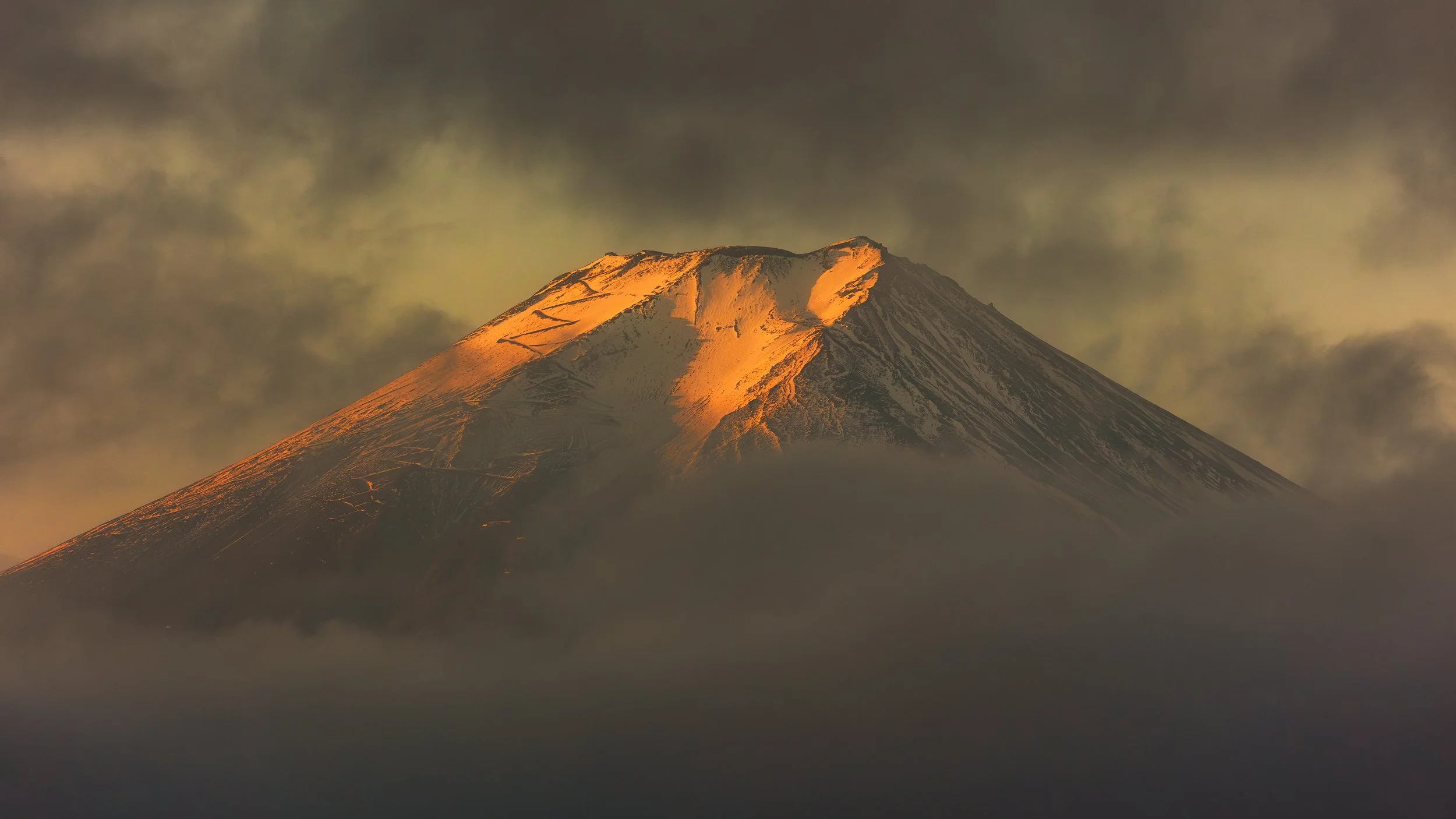
A telephoto lens compresses the scene and isolates the mountain against the autumn foliage.
5. Embrace the Weather
Not every day will be clear. In fact, most days in Japan are not.
But that's okay.
On our first day in the Fuji area, it was a complete washout. Socked in as socked in gets. But we made the most of it — we scouted the pagoda, had a laugh, and set ourselves up for the next morning.
On our last morning, the fog and clouds were so thick that we'd been walking for at least an hour and a half. We were losing hope. Then, suddenly, Fuji appeared. As I said in the vlog, "I was losing hope, you know. But wow, it really turned itself around for us."
Cloudy skies can add mood and atmosphere. Mist rolling over the mountain creates a sense of mystery. Rain can bring out the deep greens of the surrounding forest. The key is to adapt and keep shooting.

The tiniest bit of alpine glow on the tip — worth the wait.
6. The Group Dynamic
One of the best things about leading a workshop is the group dynamic.
You're constantly bouncing ideas around, and everybody's so helpful — "Try it this way. Try it that way." It's such a wonderful atmosphere to be a part of.
When the mountain didn't cooperate, we still had a good laugh. We explored narrow mountain roads, ate at weird American diners in the middle of the Japanese countryside, and shared the ups and downs of chasing Fuji.
As I said in the vlog, "It's great. You know, I've often said it before about these kinds of workshops. The group dynamic is fantastic because you're constantly bouncing ideas around."

The group dynamic — sharing the highs and lows of chasing Fuji.
A Personal Note
There is something humbling about photographing Mount Fuji.
It's been standing there for thousands of years, long before any of us picked up a camera. It will be standing there long after we're gone.
And yet, for a brief moment, you get to capture it — to frame it, to share it, to tell its story.
On that final morning, when Fuji appeared through the fog and we rushed to the water's edge, I took a two-minute exposure just to play around. The reflections were near-perfect. The texture and detail on the mountain itself were outstanding.
It was, as I said in the vlog, "absolutely wonderful. Geez. Oh my god. It's just — when you chase it and it's just so wonderful."
That's a privilege.
📌 Quick Summary
- Get there before dawn for the best reflections
- The mountain has a mind of its own — be patient
- Use the pagoda as a frame for Fuji
- Bring a telephoto lens for compression
- Embrace the weather — clouds add atmosphere
- The group dynamic makes the experience
If you want to experience Mount Fuji in all its glory — the 4am starts, the near-perfect reflections, the quiet moments at the edge of the lake, and the excitement when the mountain finally appears — I would love to have you along on my next Japan workshop.
Join Me in Japan
We'll chase Fuji from every angle, adapt to whatever conditions the mountain throws at us, and come away with images that tell the story of this incredible place.
Explore Japan Workshops →Planning your own trip? Before you go, make sure you have comprehensive travel insurance for peace of mind. I use EKTA Travel Insurance for all my adventures — it's reliable, affordable, and covers the unexpected.
